

Chamomile might be the most familiar herb in the world. A warm cup before bed is practically a ritual in many homes, and for good reason: it is gentle, caffeine-free and comforting. But can chamomile actually help you sleep or feel less anxious, or is the calm mostly coming from the cup of warm water and the quiet moment?
Researchers have tested chamomile extract in people with anxiety and insomnia, and the results are more interesting than you might expect, especially for anxiety. Here is what holds up, the doses used, and who should be careful with this daisy-family flower.
Chamomile at a glance: how strong is the evidence?
- 😟 Generalized anxietyTwo well-designed trials: a modest benefit
- 😴 Sleep qualitySeveral small trials: a small improvement
- 🌙 InsomniaTrials found little effect on diagnosed insomnia
- 🍵 DigestionLong traditional use; little modern research
- ⚠️ SafetyVery safe for most; ragweed allergy and blood thinners need care
Which chamomile, and what is in it
Most research uses German chamomile (Matricaria chamomilla, also called Matricaria recutita), the small daisy-like flower in most chamomile teas. Its best-studied compound is apigenin, a flavonoid that binds to the same brain receptors (GABA-A benzodiazepine sites) that calming drugs act on, though far more weakly. The flowers also contain an essential oil rich in bisabolol and chamazulene, which give chamomile its anti-inflammatory reputation.
😟 Anxiety: the most promising evidence
In a 2009 trial at the University of Pennsylvania, 57 adults with mild to moderate generalized anxiety disorder took chamomile extract capsules or placebo for eight weeks, starting at 220 mg a day and increasing up to 1,100 mg if needed. Anxiety scores fell significantly more in the chamomile group.
The same team then ran a longer study published in 2016. 179 people with generalized anxiety took 1,500 mg of chamomile extract a day for 12 weeks; those who improved were then randomly switched to chamomile or placebo for up to 26 more weeks. People who stayed on chamomile had fewer anxiety symptoms and were somewhat less likely to relapse, although the relapse difference was not statistically significant. They also lost a little weight and had slightly lower blood pressure.
Our read: for mild, everyday anxiety, chamomile extract has better evidence than most calming herbs, and side effects were similar to placebo. It is not a replacement for therapy or prescribed treatment, and anyone with severe anxiety, panic attacks or depression should talk to a professional.
😴 Sleep: a gentle nudge, not a sleeping pill
Several small trials have looked at chamomile for sleep. In older adults in Iran, 200 mg of chamomile extract twice a day for four weeks improved sleep quality scores compared with a control group. In a Taiwanese study of new mothers, drinking chamomile tea daily for two weeks improved sleep quality and depressive symptoms, though the benefit faded four weeks after they stopped.
For diagnosed insomnia, results are weaker. A 2011 pilot trial gave 34 adults with chronic insomnia 270 mg of chamomile extract twice a day for 28 days and found only small, non-significant improvements in sleep time and how quickly people fell asleep. A 2019 review pooling 12 trials concluded chamomile improved overall sleep quality but did not significantly help insomnia itself.
Our read: chamomile can help you wind down and may modestly improve how well you sleep, but it is not a treatment for chronic insomnia. For that, cognitive behavioral therapy for insomnia (CBT-I) has the strongest evidence.
🍵 Digestion and other traditional uses
Chamomile tea has been used for centuries for indigestion, gas and stomach cramps, and European regulators recognize it as a traditional herbal medicine for minor digestive complaints. Modern controlled research is limited. It is also used as a mouth rinse and in skin creams, again with mostly traditional and small-study support.
💊 The doses that were studied
- Anxiety: 220 to 1,100 mg a day of standardized extract (2009 trial); 1,500 mg a day (2016 trial).
- Sleep: 400 to 540 mg a day of extract, usually split into two doses, or one to two cups of tea daily.
- Tea: 1 to 2 heaped teaspoons of dried flowers (or 1 to 2 tea bags) per cup, covered and steeped for 5 to 10 minutes so the oils stay in the cup.
Liquid extracts are dosed differently, so follow the label. For sleep, take it 30 to 60 minutes before bed as part of a wind-down routine. For anxiety, the trials used daily dosing for several weeks.
How to get the most out of chamomile
- Make it part of a routine. The same time every evening, screens off, lights low. The habit amplifies the herb.
- Do not expect a knock-out effect. Chamomile is mild; that is also why it is so safe.
- Combine sensibly. If you need something stronger for sleep, our valerian root guide and magnesium for sleep article cover options with their own evidence.
- Choose a tested product. Look for German chamomile flowers and a brand that identity-tests its herbs.
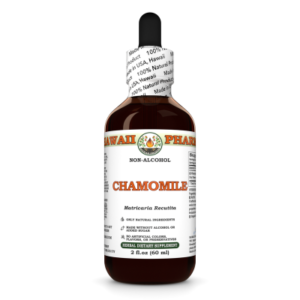
Our pick: chamomile drops
Hawaii Pharm Chamomile Alcohol-Free Liquid Extract
An alcohol-free glycerite of chamomile flowers, handy when you want something stronger than a tea bag or need it on the go. Raw materials are identity-tested in Hawaii Pharm's own lab.
- Alcohol-free glycerite (vegetable glycerin and water)
- 2 fl oz dropper bottle, about 1 ml per serving
- Raw materials identity-tested in Hawaii Pharm's lab
Affiliate link: we may earn a commission at no extra cost to you. These statements have not been evaluated by the FDA. Not intended to diagnose, treat, cure, or prevent any disease. Full disclosure.
Who should be careful
- People allergic to ragweed, daisies, marigolds or chrysanthemums. Chamomile is in the same family, and rare but serious allergic reactions have been reported.
- People taking warfarin or other blood thinners. There are case reports of increased bleeding risk, so talk to your doctor.
- People taking sedatives, sleep medication or alcohol, as effects may add up.
- People taking cyclosporine or other drugs with narrow safety margins, as chamomile may affect how some drugs are broken down.
- Pregnant women should stick to occasional cups of tea and avoid concentrated extracts unless their doctor agrees.
The honest bottom line
Chamomile is more than a comforting ritual. Two well-run trials found chamomile extract eased generalized anxiety, and several small studies suggest it modestly improves sleep quality, although it does little for true insomnia. It is one of the safest herbs you can try, with ragweed allergy and blood thinners being the main cautions. For a calmer evening and gentler sleep, chamomile is a sensible first step.
Want to try chamomile extract?
Hawaii Pharm Chamomile Alcohol-Free Liquid Extract: chamomile flowers in vegetable glycerin and water, with no alcohol. Add a dropper to warm water or tea as part of your wind-down routine.
Affiliate link. We may earn a commission if you buy, at no extra cost to you. These statements have not been evaluated by the Food and Drug Administration. This product is not intended to diagnose, treat, cure, or prevent any disease.
Frequently asked questions
Is chamomile tea as good as chamomile extract?
Tea is gentler and less concentrated. The anxiety trials used extracts at doses higher than a cup or two of tea provides. For relaxation and sleep, a strong cup of tea steeped covered for 10 minutes is a reasonable start.
Will chamomile make me drowsy during the day?
In the anxiety trials, daytime drowsiness was not a common problem. It is mildly calming rather than sedating, but see how it affects you before driving.
Can I take chamomile every night?
Yes. People drink chamomile tea daily for years, and the longest trial used extract for up to 38 weeks without safety concerns.
Studies and sources
- Amsterdam JD et al. (2009). A randomized, double-blind, placebo-controlled trial of oral Matricaria recutita (chamomile) extract therapy for generalized anxiety disorder. Journal of Clinical Psychopharmacology, via PubMed.
- Mao JJ et al. (2016). Long-term chamomile (Matricaria chamomilla L.) treatment for generalized anxiety disorder: a randomized clinical trial. Phytomedicine, via PubMed.
- Zick SM et al. (2011). Preliminary examination of the efficacy and safety of a standardized chamomile extract for chronic primary insomnia. BMC Complementary and Alternative Medicine, via PubMed.
- Adib-Hajbaghery M, Mousavi SN (2017). The effects of chamomile extract on sleep quality among elderly people: a clinical trial. Complementary Therapies in Medicine, via PubMed.
- Chang SM, Chen CH (2016). Effects of an intervention with drinking chamomile tea on sleep quality and depression in sleep disturbed postnatal women. Journal of Advanced Nursing, via PubMed.
- Hieu TH et al. (2019). Therapeutic efficacy and safety of chamomile for state anxiety, generalized anxiety disorder, insomnia, and sleep quality: a systematic review and meta-analysis. Phytotherapy Research, via PubMed.
- National Center for Complementary and Integrative Health. Chamomile. NCCIH.
- Hawaii Pharm Chamomile alcohol-free extract product page. Hawaii Pharm.
This article is for general education and is not medical advice. Talk to your doctor or pharmacist before starting a supplement, especially if you take medication, are pregnant or breastfeeding, or have a health condition. These statements have not been evaluated by the Food and Drug Administration. This product is not intended to diagnose, treat, cure, or prevent any disease.


