


Most people spend their spring trying to get rid of dandelions. Herbalists have spent a few thousand years digging them up on purpose. Dandelion root has a long history as a “bitter” for digestion and a tonic for the liver, and today it shows up in detox teas, liver blends and roasted “dandelion coffee”.
So does it actually help your digestion? The honest answer is that the traditional use is strong, the plant chemistry makes sense, and the human research is thin. Here is what we know, what we do not, and how to use dandelion root safely.
Dandelion root at a glance: how strong is the evidence?
- 🍽️ Appetite and mild indigestionApproved as a traditional use in Europe; few modern trials
- 🦠 Prebiotic fiber (inulin)Good evidence for inulin itself; little for dandelion root
- 💧 Water retentionOne small human study, using the leaf
- 🫘 Liver protectionAnimal and lab studies only
- ⚠️ SafetySafe as food; watch allergies and some medications
Root vs leaf: they are not the same remedy
The dandelion plant (Taraxacum officinale) is used in two main ways. The leaves are eaten as a bitter salad green and are traditionally used as a mild diuretic. The root is traditionally used for digestion, appetite and bile flow, and is the part roasted for dandelion coffee. When you read about a study, check which part was used, because the results do not automatically apply to the other.
🍽️ Digestion: the bitter principle
Dandelion root contains bitter compounds called sesquiterpene lactones (such as taraxacin). Bitter tastes trigger reflexes that increase saliva, stomach acid and bile, which is the logic behind taking bitters before a heavy meal. Germany’s Commission E and the European Medicines Agency both recognize dandelion root as a traditional herbal medicine for temporary loss of appetite and mild digestive complaints such as bloating, fullness and flatulence.
“Traditional use” in Europe means the herb has been used safely for at least 30 years and the effect is plausible. It does not mean it has been proven in modern controlled trials, and for dandelion root on its own, it largely has not.
Our read: a reasonable thing to try for occasional bloating or a sluggish appetite after rich meals. It is not a treatment for reflux, ulcers, IBS or any diagnosed condition, and ongoing digestive symptoms deserve a proper check-up.
🦠 Inulin: the prebiotic angle
Dandelion root is a natural source of inulin, a soluble fiber that your gut bacteria ferment into short-chain fatty acids. Inulin in general is well studied: it can increase bifidobacteria and soften stools. Roots dug in autumn contain much more inulin than roots dug in spring.
The catch is the dose. Prebiotic studies typically use 5 to 10 grams of inulin a day. A cup of dandelion root tea or a dropper of liquid extract provides only a small fraction of that. If feeding your gut bacteria is your main goal, foods like onions, garlic, leeks, asparagus, slightly green bananas, oats and beans will do more. Dandelion root is a nice bonus, not a fiber supplement.
💧 Water retention
In a small 2009 pilot study, 17 volunteers took a dandelion leaf extract and urinated more often in the hours after their doses. There was no placebo group, and it used the leaf rather than the root. Dandelion is sometimes sold for bloating and “water weight”, but if you have swollen ankles or legs, see a doctor first, as fluid retention can be a sign of heart, kidney or liver problems.
🫘 The liver detox claim
Dandelion root is a staple of “liver detox” blends. In animal studies, dandelion extracts reduced fat build-up and markers of liver damage, and in lab studies they act as antioxidants. There are no good human trials showing that dandelion root detoxifies the liver or treats liver disease. Your liver and kidneys do the detox work themselves. For more on this, see our honest review of liver detox supplements.
💊 How dandelion root is traditionally used
- Tea (decoction): simmer 1 to 2 teaspoons of chopped dried root in a cup of water for 10 minutes, up to three times a day. European monographs list about 3 to 4 grams of dried root a day.
- Roasted root “coffee”: a caffeine-free, slightly bitter coffee substitute. Roasting reduces some of the inulin.
- Liquid extract: taken in a little water about 15 to 30 minutes before meals, which suits the bitter-digestive tradition. Follow the label dose.
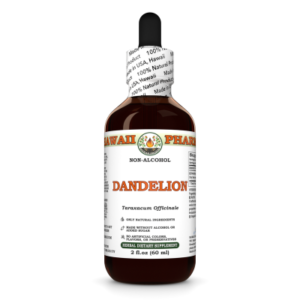
Our pick: dandelion root drops
Hawaii Pharm Dandelion Root Alcohol-Free Liquid Extract
An alcohol-free glycerite of dandelion root, easy to take in a splash of water before meals. Raw materials are identity-tested in Hawaii Pharm's own lab.
- Alcohol-free glycerite (vegetable glycerin and water)
- 2 fl oz dropper bottle, about 1 ml per serving
- Raw materials identity-tested in Hawaii Pharm's lab
Affiliate link: we may earn a commission at no extra cost to you. These statements have not been evaluated by the FDA. Not intended to diagnose, treat, cure, or prevent any disease. Full disclosure.
Who should be careful
- People allergic to ragweed, daisies, chamomile or marigolds. Dandelion is in the same plant family and can cause allergic reactions.
- Anyone with gallstones or a blocked bile duct, because dandelion root may stimulate bile flow. Ask your doctor first.
- People taking diuretics, lithium or potassium-sparing medications, as dandelion’s diuretic effect and potassium content could interact.
- People taking certain antibiotics (quinolones such as ciprofloxacin), whose absorption may be reduced. Separate doses and check with your pharmacist.
- People on diabetes medication, as some animal studies suggest a blood-sugar-lowering effect.
- Pregnant or breastfeeding women, as medicinal doses have not been studied. Eating the greens as food is fine.
Mild heartburn or an upset stomach are the most commonly reported side effects.
The honest bottom line
Dandelion root is a gentle, food-grade bitter with centuries of use for appetite and mild indigestion, and European regulators accept it for that traditional purpose. It brings a little prebiotic inulin, but not enough to replace fiber-rich foods. The bigger promises, liver detox included, rest on animal studies. Used before meals as part of a fiber-rich diet, it is a sensible, low-risk tool for occasional digestive discomfort, as long as you check for the allergies and medication interactions above.
Want to try dandelion root?
Hawaii Pharm Dandelion Root Alcohol-Free Liquid Extract: dandelion root in vegetable glycerin and water, with no alcohol and a mildly sweet taste that softens the bitterness.
Affiliate link. We may earn a commission if you buy, at no extra cost to you. These statements have not been evaluated by the Food and Drug Administration. This product is not intended to diagnose, treat, cure, or prevent any disease.
Frequently asked questions
Can I use dandelions from my yard?
Only if you are certain they have not been sprayed with weedkiller or fertilizer, and are not near roads or where pets go. Identification matters too, as several look-alike plants exist. For most people, a tested commercial product is the safer choice.
When should I take dandelion root for digestion?
Traditionally, 15 to 30 minutes before meals, so the bitter taste can prime digestion. Taking it in a little water rather than a capsule keeps the bitter taste, which is part of how it is thought to work.
Is dandelion root coffee healthier than coffee?
It is caffeine-free, which helps if caffeine upsets your sleep or stomach. Regular coffee has its own well-researched benefits, though, so it is a matter of what suits you rather than one being healthier.
Studies and sources
- Clare BA et al. (2009). The diuretic effect in human subjects of an extract of Taraxacum officinale folium over a single day. Journal of Alternative and Complementary Medicine, via PubMed.
- European Medicines Agency. Community herbal monograph on Taraxacum officinale (dandelion root with herb). EMA.
- National Center for Complementary and Integrative Health. Dandelion. NCCIH.
- Wirngo FE et al. (2016). The physiological effects of dandelion (Taraxacum officinale) in type 2 diabetes. The Review of Diabetic Studies, via PubMed.
- Hawaii Pharm Dandelion Root alcohol-free extract product page. Hawaii Pharm.
This article is for general education and is not medical advice. Talk to your doctor or pharmacist before starting a supplement, especially if you take medication, are pregnant or breastfeeding, or have a health condition. These statements have not been evaluated by the Food and Drug Administration. This product is not intended to diagnose, treat, cure, or prevent any disease.


