

In India, holy basil grows in courtyards and temple gardens, and its name, tulsi, means “the incomparable one”. In Ayurveda it has been used for thousands of years as a rasayana, a herb taken to build resilience. Today it is sold as an adaptogen: a plant said to help your body cope with stress. Tulsi tea, capsules and drops promise calmer days, better sleep and steadier blood sugar.
That is a lot of promises for one leaf. We went through the human trials to sort out what holy basil can realistically do for stress, what the doses were, and who should leave it on the shelf.
Holy basil at a glance: how strong is the evidence?
- 😮💨 Everyday stressSeveral small trials: a modest benefit
- 😴 Sleep under stressOne good trial: better sleep scores
- 😟 AnxietyOne small, older study: possible benefit
- 🩸 Blood sugarSmall trials: a small drop, needs care with medication
- ⚠️ SafetyGenerally well tolerated; avoid in pregnancy
What holy basil is (and is not)
Holy basil (Ocimum tenuiflorum, also called Ocimum sanctum) is a cousin of the sweet basil in your kitchen, but it tastes very different: peppery, clove-like and slightly minty. The leaves contain eugenol, rosmarinic acid, ursolic acid and other plant compounds that have anti-inflammatory and antioxidant effects in the lab.
“Adaptogen” is not a medical term, and there is no single test that proves a herb is one. What we can check is whether people who take holy basil report less stress, sleep better or show changes in stress markers like cortisol, compared with people taking a placebo.
😮💨 Stress: what the trials found
In a 2012 Indian trial of 150 adults with stress symptoms, people who took 1,200 mg a day of a holy basil extract for six weeks reported a bigger drop in stress symptoms, such as forgetfulness, exhaustion and sleep problems, than people on placebo.
The most careful trial so far was published in 2022. Australian researchers gave 100 stressed but otherwise healthy adults either 125 mg of a standardized holy basil extract twice a day or a placebo for eight weeks. The holy basil group reported lower stress, and their hair cortisol (a longer-term stress marker) was lower too, although the differences on some questionnaires were modest.
A 2017 systematic review pulled together 24 human studies of holy basil and concluded that it showed favorable effects on stress, metabolic health and cognition, but most studies were small, short and of mixed quality.
Our read: holy basil has some of the better human evidence among stress herbs after ashwagandha. The effect is real but modest: think “takes the edge off”, not “replaces therapy”. If stress is affecting your health, work and relationships, please talk to a professional.
😴 Sleep
In the 2022 Australian trial, sleep quality improved more in the holy basil group than with placebo. That fits with what people describe: less of the racing, wired feeling at bedtime. It is one study, so we would call this promising rather than proven.
😟 Anxiety
An older study from Nepal gave 35 people with generalized anxiety disorder 500 mg of holy basil extract twice a day for 60 days and reported less anxiety, stress and depression. It had no placebo group, so we cannot tell how much of the improvement came from the herb. Anxiety disorders respond well to proven treatments, so start there.
🩸 Blood sugar
Several small trials in people with type 2 diabetes or prediabetes found holy basil leaf lowered fasting blood sugar a little. That is good news for some, but it also means people on diabetes medication should only use holy basil with their doctor’s knowledge, because the two together could push blood sugar too low.
💊 The doses that were studied
- Standardized extract: 250 mg a day (125 mg twice daily) in the 2022 trial.
- General extract: 1,000 to 1,200 mg a day in older trials, split into two or three doses.
- Tea: 1 to 2 teaspoons of dried leaf per cup, one to three cups a day, is the traditional approach. It is milder and less studied.
For liquid extracts, follow the label and start low. Most trials lasted six to eight weeks, so give it at least that long before deciding if it helps you.
How to use holy basil sensibly
- Pair it with habits that work. Daily movement, regular sleep times, time outdoors and limiting alcohol and late caffeine all have stronger evidence for stress than any herb.
- Take it consistently. Adaptogens are studied as daily supplements, not one-off rescue doses.
- Choose a tested product. Look for brands that identity-test their herbs, and that list the plant part (leaf) and species.
- Mind the alcohol. Traditional tinctures contain alcohol. Glycerites are an alcohol-free option.
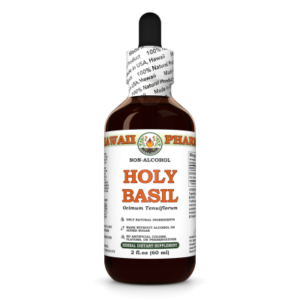
Our pick: holy basil (tulsi) drops
Hawaii Pharm Holy Basil (Tulsi) Alcohol-Free Liquid Extract
An alcohol-free glycerite of holy basil leaf, easy to add to water or a cup of tea. Raw materials are identity-tested in Hawaii Pharm's own lab.
- Alcohol-free glycerite (vegetable glycerin and water)
- 2 fl oz dropper bottle, about 1 ml per serving
- Raw materials identity-tested in Hawaii Pharm's lab
Affiliate link: we may earn a commission at no extra cost to you. These statements have not been evaluated by the FDA. Not intended to diagnose, treat, cure, or prevent any disease. Full disclosure.
Who should be careful
- Pregnant women and couples trying to conceive. Animal studies suggest holy basil may affect fertility and pregnancy, so avoid it.
- People on diabetes medication, because of the blood-sugar effect.
- People on blood thinners such as warfarin, or with surgery coming up, because holy basil may slow clotting. Stop at least two weeks before surgery.
- Anyone with an underactive thyroid, as one animal study found lower thyroid hormone levels. Check with your doctor.
Side effects in the trials were mild and uncommon, mostly nausea or loose stools.
The honest bottom line
Holy basil is a gentle, reasonably well-studied herb for everyday stress. A handful of placebo-controlled trials found people felt less stressed and slept a little better after six to eight weeks, and one found lower cortisol. It is not a cure for anxiety disorders and should be used carefully alongside diabetes or blood-thinning medication. As part of a calmer routine, a daily cup of tulsi tea or a few drops of extract is a sensible, low-risk thing to try.
Want to try holy basil?
Hawaii Pharm Holy Basil (Tulsi) Alcohol-Free Liquid Extract: holy basil leaf in vegetable glycerin and water, with no alcohol. Add it to water or your evening tea.
Affiliate link. We may earn a commission if you buy, at no extra cost to you. These statements have not been evaluated by the Food and Drug Administration. This product is not intended to diagnose, treat, cure, or prevent any disease.
Frequently asked questions
Is holy basil the same as the basil I cook with?
No. Sweet basil (Ocimum basilicum) is a close relative, but holy basil is a different species with a different flavor and chemistry. The stress studies used holy basil specifically.
Holy basil or ashwagandha for stress?
Ashwagandha has more and larger trials behind it for stress and sleep. Holy basil is gentler and may suit people who do not tolerate ashwagandha. Some people use both, but start one at a time so you can tell what is working. See our ashwagandha guide for a comparison.
Can I take holy basil every day?
In studies, people took it daily for up to about three months without serious problems. Long-term safety beyond that is less well studied, so it is reasonable to take a break every few months.
Studies and sources
- Jamshidi N, Cohen MM (2017). The clinical efficacy and safety of tulsi in humans: a systematic review of the literature. Evidence-Based Complementary and Alternative Medicine, via PubMed.
- Saxena RC et al. (2012). Efficacy of an extract of Ocimum tenuiflorum (OciBest) in the management of general stress: a double-blind, placebo-controlled study. Evidence-Based Complementary and Alternative Medicine, via PubMed.
- Lopresti AL et al. (2022). A randomized, double-blind, placebo-controlled trial investigating the effects of an Ocimum tenuiflorum (Holy Basil) extract (Holixer) on stress, mood, and sleep in adults experiencing stress. Frontiers in Nutrition, via PubMed.
- Bhattacharyya D et al. (2008). Controlled programmed trial of Ocimum sanctum leaf on generalized anxiety disorders. Nepal Medical College Journal, via PubMed.
- Hawaii Pharm Holy Basil alcohol-free extract product page. Hawaii Pharm.
This article is for general education and is not medical advice. Talk to your doctor or pharmacist before starting a supplement, especially if you take medication, are pregnant or breastfeeding, or have a health condition. These statements have not been evaluated by the Food and Drug Administration. This product is not intended to diagnose, treat, cure, or prevent any disease.


